The Baltimore Sun published another article about Pig Point on Sunday, August 14, explaining some of our recent discoveries about the site. Check it out! If you haven't been to the site in a while, come out for a visit when we're out there. Contact Jessie to get the schedule.
Monday, August 15, 2011


Exciting News from Pig Point!
This summer at Pig Point, LTP intern Elizabeth Fuhr worked in the Upper Block and got to spend some time digging a feature that is the source of some incredibly exciting news! Liz authored the post below:
In July, a small feature at Pig Point (18AN50) was excavated. This feature, now known as Feature 178, was found intruding into Stratum 12 in Unit 70. It was found to contain ash and charcoal. The charcoal was sent to a lab to be carbon dated and we recently received the results. The charcoal dates back to BC 7340 - 7070, over 9000 years ago! This dates this feature back to the Early Archaic.
Radiocarbon dating is a technique utilized by many archaeologists. This technique involves measuring the loss of the isotope Carbon-14. This isotope accumulates during the life of organisms. At death, the isotope will decay at a constant rate; in which the half life is 5730 years. By measuring the amount of the isotope left within the organism, the age of the organism can be found.
 |
| Elizabeth Fuhr holds a projectile point that she found on site! |
This is not only the oldest date from good context we have from Pig Point, but it is also the oldest date from good context in the state of Maryland. The difference between a good and bad context is determined by the location in which the material is located. A good location has direct cultural connections: the carbonized material is found in an intact feature and the feature hasn't been disturbed by animals or other similar things. Older carbon-14 dates exist in Maryland, but not with direct cultural associations like Feature 178.
A Kirk Palmer point was found about 15 feet away from the feature, and temporally coincides very well with Feature 178. This point was found on top of heavy gravel while Feature 178 intruded into the gravel.
This new date is wonderful news for Pig Point, the Lost Towns Project, and archaeology in Maryland!
Friday, July 29, 2011
Interns Blog: Piscataway Drill
For this blog, intern Stephanie Baldwin writes about an artifact that caught her eye in the field...
Piscataway Drill (rose quartz) – Late Archaic Period
 |
| Drill modified from a Piscataway point. |
I chose to write about the Piscataway Drill that was found July 12, 2011 at Pig Point (18AN50) in Feature 11 Stratum G of Unit 51. Although I was working in Unit 80, not the feature that this point was found, the beauty of this point found at the same site sparked my interest in Late Archaic projectile points. This drill is made of a beautiful rose quartz. At the bottom of the drill there is a darker hue of rose/pink, and it gradually lightens into a light rose/pink at the tip.
This drill/knife could have possibly been made as a projectile point and re-sharpened into a drill or had been originally made as a drill. Although the tip of the drill/knife is broken off, it is evident to see that it has a drill shape to it. The term Piscataway [Stemmed] Points was coined by Stephenson, et al. in 1963. In the book Material Culture from Prehistoric Virginia, Wm Jack Hranicky explains the basic description of the Piscataway Points: “Stemmed; it is a small-to-medium, long and narrow point with contracting and pointed stems. Bases are usually pointed but rounded bases do occur” (614). This points date to the Late Archaic Period (3500 B.C. – 1000 B.C.).
A recent paper written by Al Luckenbach, Jessie Grow, and Shawn Sharpe explains some very interesting findings associated with Piscataway [Stemmed] Points. This paper describes the stratigraphy and chronology of the Pig Point site and discusses the regional implications of the results obtained for Piscataway and triangular points (Luckenbach et al.: 3). While triangle points are commonly associated with the Late Woodland period (A.D. 900 – A.D. 1650), triangle points at Pig Point are being found in situ and associated with Piscataway points from the Archaic period. This indicates that triangle points were used in at least two different periods of prehistory.
Originally the beauty of this point caught my eye, but now the history behind this point makes it so much more fascinating! It proves what archaeologists' say, “It’s not what you find, but what you find out.”
Friday, July 15, 2011
Two new Patch Articles
 |
| Photo of Pat Melville taken by David Pecor for the Volunteer Q&A article. |
The Edgewater-Davidsonville Patch published two more articles about Pig Point and the Lost Towns Project this week. Part III is about lab work and volunteer and internship opportunities. The final article is a Q&A with our volunteer Pat Melville. Both are fantastic and you can check them out below!
http://edgewater.patch.com/articles/part-iii-archeology-site-at-pig-point-continues-to-yield-ancient-treasures
Friday, July 8, 2011
Death of a Digloo
Written by Lauren Schiszik, LTP Staff
It's the end of an era at London Town. Yesterday, the Rumney's Tavern Digloo (translation: igloo that we dig in) was dismantled. After more than a decade of sheltering the earthen cellar-hole of Rumney's Tavern, it was taken down in preparation for bigger and better things. The Rumney/West Tavern will be reconstructed in the same manner as the Lord Mayor's Tenement and the Carpenter's Shop at London Town. Before we do that, however, we need to excavate more postholes to figure out what exactly the footprint of the building should be. Some of the postholes were inaccessible because the digloo frame was on top of them! Now that it's gone, we can excavate and analyze the postholes and determine the chronology of building constructions, additions, and demolitions related to Rumney's. It's going to be a busy field season at London Town - and it doesn't look quite the same. Come check it out!
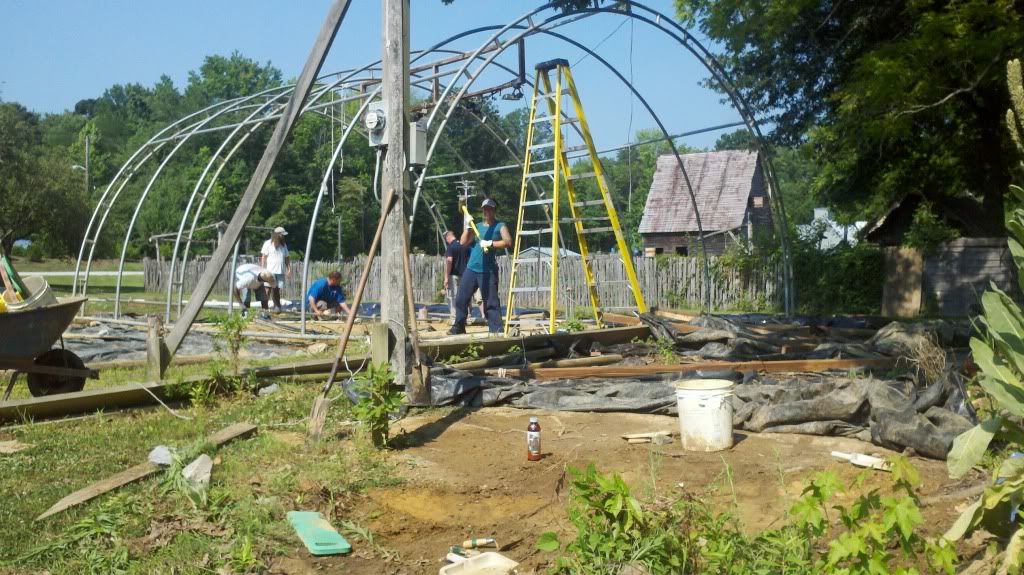 |
| Shawn and Erin take a break from excavating to help take down the Digloo frame. |
It's the end of an era at London Town. Yesterday, the Rumney's Tavern Digloo (translation: igloo that we dig in) was dismantled. After more than a decade of sheltering the earthen cellar-hole of Rumney's Tavern, it was taken down in preparation for bigger and better things. The Rumney/West Tavern will be reconstructed in the same manner as the Lord Mayor's Tenement and the Carpenter's Shop at London Town. Before we do that, however, we need to excavate more postholes to figure out what exactly the footprint of the building should be. Some of the postholes were inaccessible because the digloo frame was on top of them! Now that it's gone, we can excavate and analyze the postholes and determine the chronology of building constructions, additions, and demolitions related to Rumney's. It's going to be a busy field season at London Town - and it doesn't look quite the same. Come check it out!
Friday, July 1, 2011
A Day out in the Field
This summer, we are having our interns write blogs about their experiences doing archaeology. I am posting this one a bit belatedly - sorry Patrick!
- Lauren
Written by Patrick Collins, Lost Towns Project Intern
Today, Thursday, June 16, 2011, was an interesting day out in the field at Londontown. I learned more about digging into a feature, which is where a post was most likely placed in the past when people such as American Indians or British settlers were constructing things such as wigwams or houses. I also learned once more about how exactness, in terms of things such as measurements, is crucial when it comes to excavating. I also learned how an area that has been dug into, such as a feature, cannot be dated solely by an artifact that has been found within it. An archaeologist that I was working with mentioned how a coin that could say 1700 on it could be found in a stratum or layer in the ground that is from a time much later than 1700.
- Lauren
Written by Patrick Collins, Lost Towns Project Intern
 |
| From left to right: Interns Patrick Collins and Jillie Drutz help Steph fill out paperwork at Pig Point. |
Later on I then continued waterscreening, which is something that I am very familiar with now. Waterscreening involves basically a net and a hose, and it is used for separating dirt from artifacts by spraying dirt away from the artifacts until the dirt filters through the net and only pieces of gravel and artifacts remain above the net. Today was an interesting day for waterscreening because I found some interesting artifacts such as pieces of plates that were most likely used by the colonial settlers at Londontown. I also found a piece of pottery, which I believe may have come from American Indian origin, and I found a bunch of bones from another pile of dirt that I waterscreened as well.
Part II of Pig Point article
Hi folks -
Here's the link to the second part of the Edgewater-Davidsonville Patch article on Pig Point.
http://edgewater.patch.com/articles/part-ii-pig-point-artifacts-may-be-helping-to-re-write-history
Check out the photo gallery too - there are some great shots. Happy reading and enjoy the Fourth of July weekend!
- Lauren
Here's the link to the second part of the Edgewater-Davidsonville Patch article on Pig Point.
http://edgewater.patch.com/articles/part-ii-pig-point-artifacts-may-be-helping-to-re-write-history
Check out the photo gallery too - there are some great shots. Happy reading and enjoy the Fourth of July weekend!
- Lauren
Subscribe to:
Comments (Atom)